Shift changeovers in senior living communities happen three times a day.
In fifteen to thirty minutes, outgoing staff pass along critical resident care details — things like unfinished tasks, residents who have recently gone on alert, changes in health or behavior, and so much more.
A clear and complete handoff supports continuity of care. A rushed or inconsistent handoff can lead to care gaps.
The research on this is extensive, and most of it is sobering.
Approximately 80% of serious medical errors in healthcare settings involve miscommunication during patient handovers between caregivers. Yet only 6.3% of nurses report that the shift-change handoffs they receive are "always" accurate, complete, and pertinent to the resident's condition. On average, shift sign-outs capture only about 45% of the information elements required for safe care.
That 55% gap is where things can go wrong.
Why verbal handoffs are hard to do well
The shift changeover is structurally difficult. Outgoing caregivers are tired and managing end-of-shift responsibilities. Incoming caregivers are orienting themselves. Time is short and the volume of information is high, especially as resident acuity continues to rise across senior living.
The average assisted living resident is 87 years old, and more than 94% have at least one chronic medical condition. Many live with Alzheimer's or another form of dementia. The details that matter most — a subtle behavioral change, a refusal to eat, an overnight alert — are exactly the kind of information that gets dropped in a rushed verbal exchange.
The documentation trap
The instinct is to rely on written notes as a backstop. But that doesn't reliably solve the problem.
Paper notes get lost. Electronic notes go unread. Caregivers already stretched thin have limited bandwidth to search documentation systems for what matters. And even when outgoing caregivers do write things down, the record depends on memory and interpretation. A detail that seems minor in the moment — a resident who seemed quieter than usual, or who declined a medication — may not make it into any formal record at all.
What continuity of care actually requires
Continuity of care across shifts requires three things: relevant information captured during the shift, organized in a way that is easy to review, and visible to the incoming caregiver before they start interacting with residents.
The communities that run shift transitions well tend to share a few common practices: a structured format for the handoff conversation, a documented record that incoming caregivers can reference, and a consistent expectation of reviewing resident-specific details rather than relying on caregivers to volunteer whatever they remember.
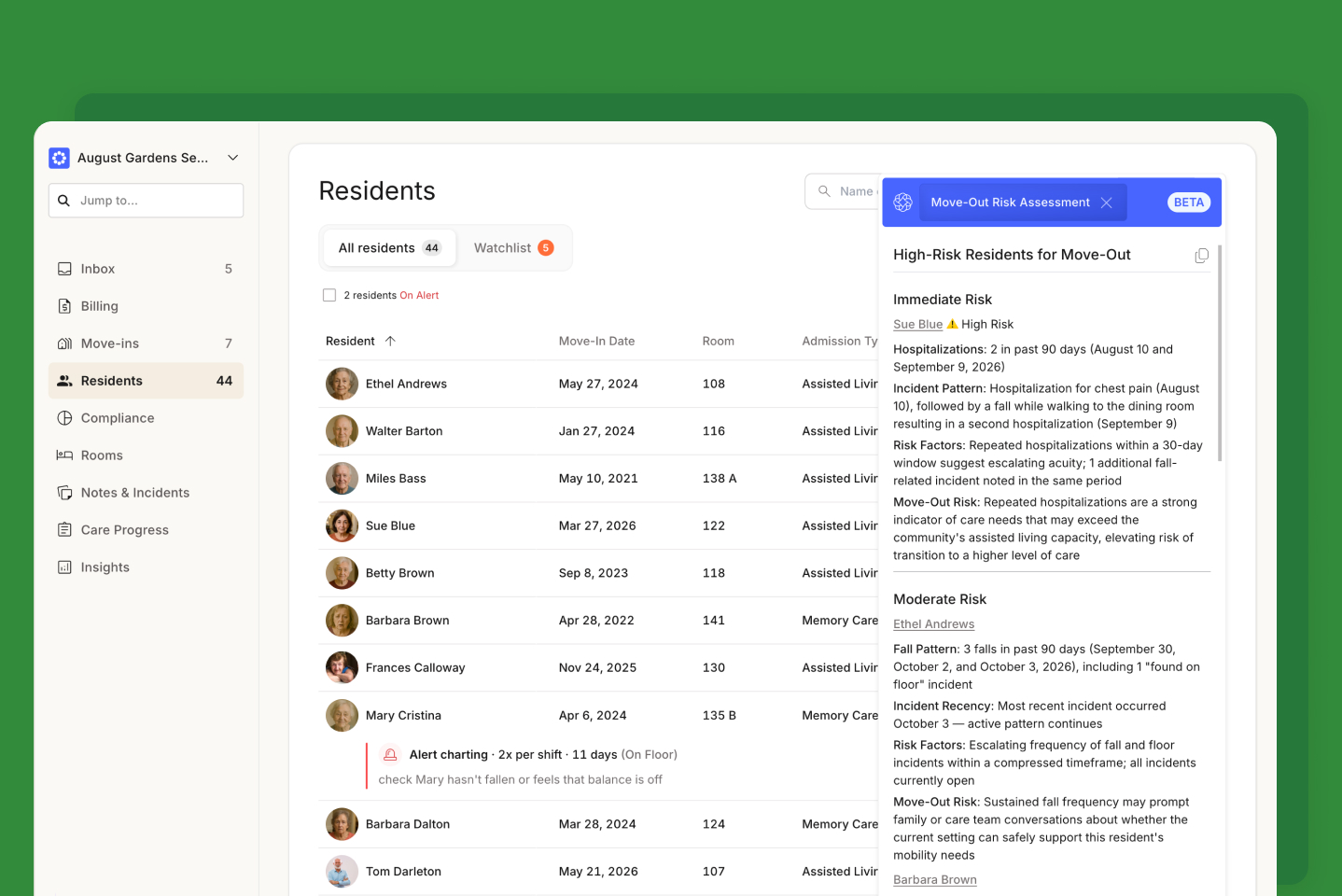
Digital tools can support all three. When care events are captured throughout the shift and automatically organized into a clear summary, the incoming caregiver arrives with a documented picture of what happened — who is on alert, what routines were missed, what needs follow-up. The verbal conversation becomes an extension of that record.
The shift change will always be a moment of knowledge transfer. What's worth asking is how much of that knowledge actually makes it to the next shift.