James Kesler is walking through one of his communities — he does this often, just walking — when he spots a children's book in a resident's room. He picks it up. He doesn't put it right back.
"Is this your grandchild's favorite book?" he might ask. "Is that why you have it?" And then he'd read a couple of pages, right there in the doorway.
The moment lasts fifteen seconds. But for a resident whose world has narrowed to the present tense — whose memory surfaces and retreats like a tide — those fifteen seconds are the whole world.
"That moment of engagement is meaningful," James says. "She may forget it. But she was there for it, and so were we."
This is the operating philosophy of 1019 Senior Living, a family-owned company headquartered in Anderson, Indiana, with five communities across the state and in Cincinnati. Its founders, Heather and James Kesler, call it making moments matter.
The date on the door
The company is named after October 19th — the date Heather and James got married. It's there as a statement of intent: the values that run a family are the values that run this company.
Heather grew up around long-term care. Her mother was an administrator. She started attending Sunday services and then visiting residents afterward as a child, absorbing the culture before she had language for it. Later, while in school, she started working nights as a CNA.
James came to senior living by a different road. His family had a military background, and those values traveled with him. Loyalty was foundational. His father often told him to respect teachers, even when you didn't like them — much like the adage Heather's own father would return to: it's never wrong to do the right thing.
When the two of them sat down to name their core values as a company, no marketing team was in the room. It took about five minutes to choose three: integrity, loyalty, and respect — the same three things their families had each arrived at separately, traveling with them through every job, every career pivot, every hard decision.
"We believe that every interaction we have builds a relationship — and all care happens within that relationship."— Heather Kesler
That belief shapes everything: how residents are treated, how staff are onboarded, and even the tools they choose.
The train in the station
The communities 1019 Senior Living acquires share a recognizable profile: financially distressed, understaffed, citation-heavy, and sometimes so depleted that the residents remaining inside feel less like a community than a holdover. "The train was just sitting there in the station," James says. "It wasn't moving."
What 1019 brings in is less a playbook than a question: what would life look like here if residents were fully engaged?
Every operational decision — staffing, programming, communication, care — flows backward from that vision.
The results are measurable. One community they acquired had 12 residents in a home built for 37. Today, 32 of those 37 apartments are full. That growth came from a culture families could feel the moment they walked in the door.
Part of building that culture is an unusual commitment to honesty. Every year, James and Heather hold community meetings where residents name what they want — a bus, new dinnerware, whatever's on their minds — and 1019 writes it down and shows up the following year with answers. "We can't do a swimming pool," James will say frankly. "But we'll get you the bus." And they do.
The same honesty governs harder conversations: when a resident's savings are nearly gone, 1019 doesn't hand them a referral to a nursing home. James sits with the family, looks at the social security income, and finds a number that keeps the resident in place until, as he puts it, they're "called home."
"Doing the right thing works out," Heather says. "And it compounds on itself."
That philosophy applies to staff just as naturally as it does to residents — because for Heather and James, the two are inseparable.
Every Wednesday at 10 a.m., they personally meet every new hire across all five communities by video, learning which caregiver needs to leave early for a grandchild's baseball game and whose husband plays in the orchestra.
Their personal cell numbers go to every team member and every resident’s family. In the entire history of 1019, they've received fewer than five negative calls.
After 180 days of employment, any staff member who wants CNA certification gets sent to school. Each year, 1019 Senior Living fully funds one LPN scholarship, with no obligation to stay on the team — because, as Heather says, "if we've identified someone who's going to be a good nurse for seniors, it's okay if they work somewhere else. They're going to take care of someone."
Their children, Zoe and Sam, now work in the company too. Zoe completed a six-month unpaid administrator-in-training program while working overnight hospital shifts; Sam came home from a year-long National Guard deployment in Africa on a Saturday and was on the maintenance team Monday morning. What began as a company became a legacy.
How 1019 Senior Living uses August Health
By the time Heather Kesler began looking for a platform to run her own communities, she had already lived through several EHR implementations.
The industry-wide mandate to go electronic had arrived during her years in skilled nursing, and she had watched, system by system, as well-intentioned software piled complexity onto the people who could least afford it: the frontline caregivers whose attention was supposed to be on residents.
That’s why, when 1019 Senior Living evaluated platforms, August Health stood out.
Today, 1019 Senior Living runs its full operations on August Health — from Move-Ins, where new residents' preferences, routines, and personal history are captured at the point of entry, through its EHR and eMAR for clinical records and medication administration, to Billing & Payments across all five communities.
But ease of use was only part of the appeal. The deeper case for August Health was about what the platform could do for care itself — specifically, preserving the relational knowledge that a primary caregiver builds over months, but that disappears the moment they call in sick.
"Let's say a resident is resistive to getting a shower. But I know her soothing song is going to be Rod Stewart. I play some Rod Stewart, warm the water up — now she's relaxed. That's technology information you may not retain in your head, but you can see it in August Health. And then you can implement it."— James Kesler
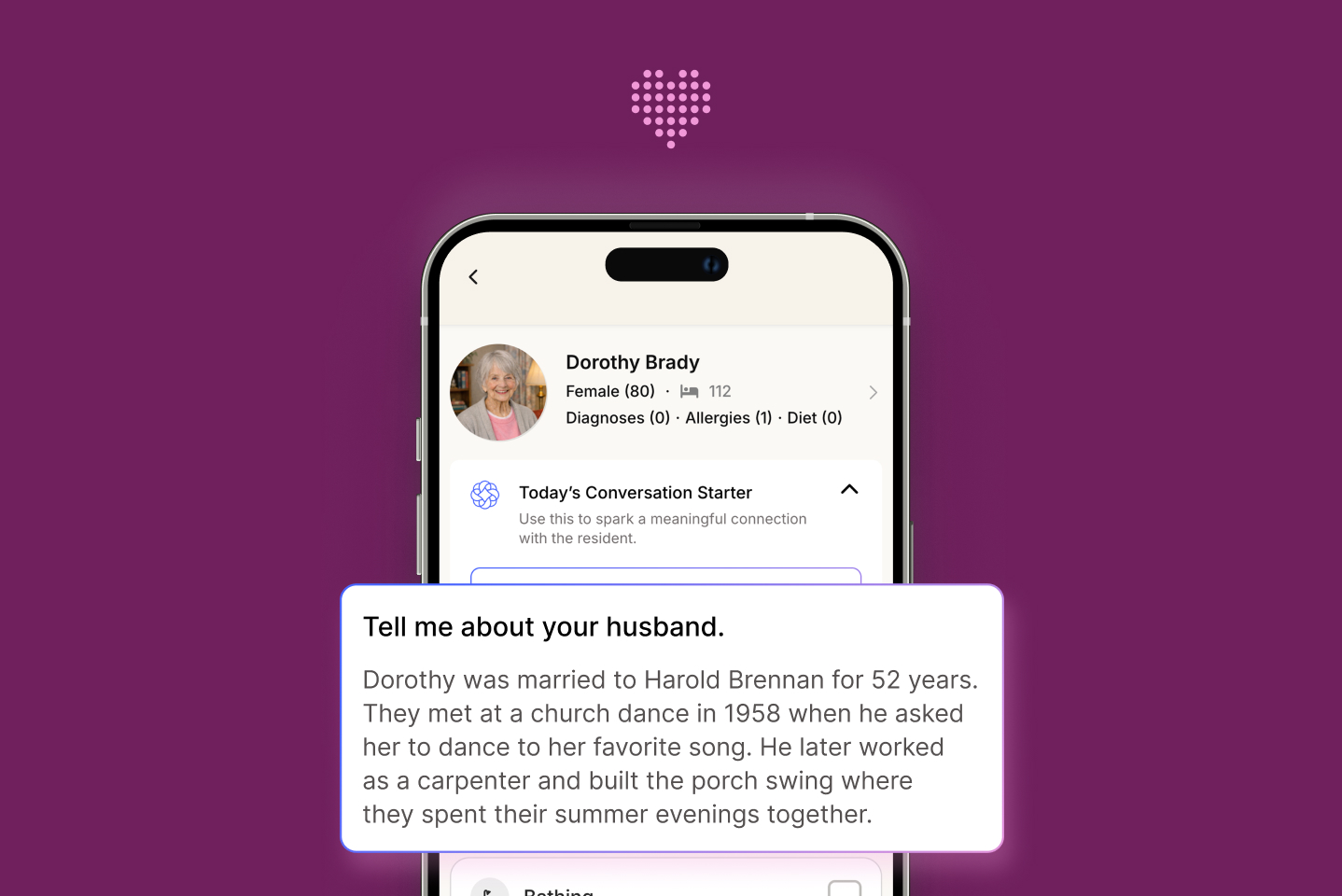
August Health's EHR does something a paper chart never could: surfacing the right detail — a music preference, a food aversion, a personal care routine — for the right caregiver, at the right moment. Instead of that knowledge belonging to one or two people, it belongs to the whole team, available to any caregiver walking through that door.
The same logic applies to what caregivers observe but don't always know how to escalate. When 1019 Senior Living runs its Wednesday onboarding calls and asks new hires what they need most, James says roughly ninety percent of the time, someone mentions communication — and about half of those come down to the same desire: I want to know what's happening with my residents.
August Health closes that loop, giving frontline staff a structured way to flag what they're seeing, and ensuring those observations reach decision-makers rather than fading between shifts.
"With August Health, caregivers will have a way to communicate what they observe. It's not just going to fall on deaf ears. It'll be right there — 'Hey, Fred's not doing well. What are we going to do about it?'"— James Kesler
August Health’s latest features like Shift Handoff are designed precisely for this: the missed shower, the changed routine, the piece of information that would otherwise fall in the gap between one caregiver's knowledge and the next.
AI-powered caregiver tools are coming, too, and James is paying close attention. "I'm excited to see where August Health is twenty-four months from now," he says. "Every step of the way, they've been building — module after module."
“The best French toast I've ever had”
Earlier this year, James and Heather took their mothers to Hana, Maui — a remote stretch of coastline James describes as what Hawaii looked like a hundred years ago.
It was a bucket list trip for both mothers, who had each planned to visit with their husbands. But both their spouses were now gone, and James's mother had Alzheimer's that severely impacted her short-term memory.
Each morning in Hana, they walked to the same restaurant. And each morning, she looked around as if arriving somewhere new.
The Hawaiian toast — essentially French toast — would arrive, and she’d taste it.
"This is the best French toast I've ever had," she’d say.
Every single morning.
On the flight home, she turned to James and said she couldn't wait to get to Hawaii.
He took out his phone and showed her the photos. Waterfalls. The beach. Her face, bright in the sun.
"Oh, we did," she said. "Look how great."
James shared the story not as a tragedy, but as an instruction. Because it is the same thing he and Heather are trying to build into every community, every Wednesday onboarding call, every service plan, and every data point logged in August Health.
"Not because they're going to remember it," he says. "But because, in the moment, they're having a ball."
1019 Senior Living is a company made of moments. Five communities across Indiana and Ohio, hundreds of residents, and a family business now extending into a second generation — all organized around the same belief: that the moments that feel smallest are the ones that matter most, and that the right values, the right team, and the right tools can make sure none of them get lost.