When you think of AI, you probably picture a chatbot: an expanded search bar that requires you to stop what you're doing, type a prompt, and explicitly ask for information. It sounds simple enough, but it typically requires many follow-up questions and prompt adjustments to get the output you were actually hoping for.
For many technology vendors, that is exactly what they mean when they say "AI". But let's be honest: a nurse or caregiver stretched to their limit doesn't have time to interview a bot. They are on the floor working with residents every day, and need AI that works proactively for them, not one that leaves them chasing answers.
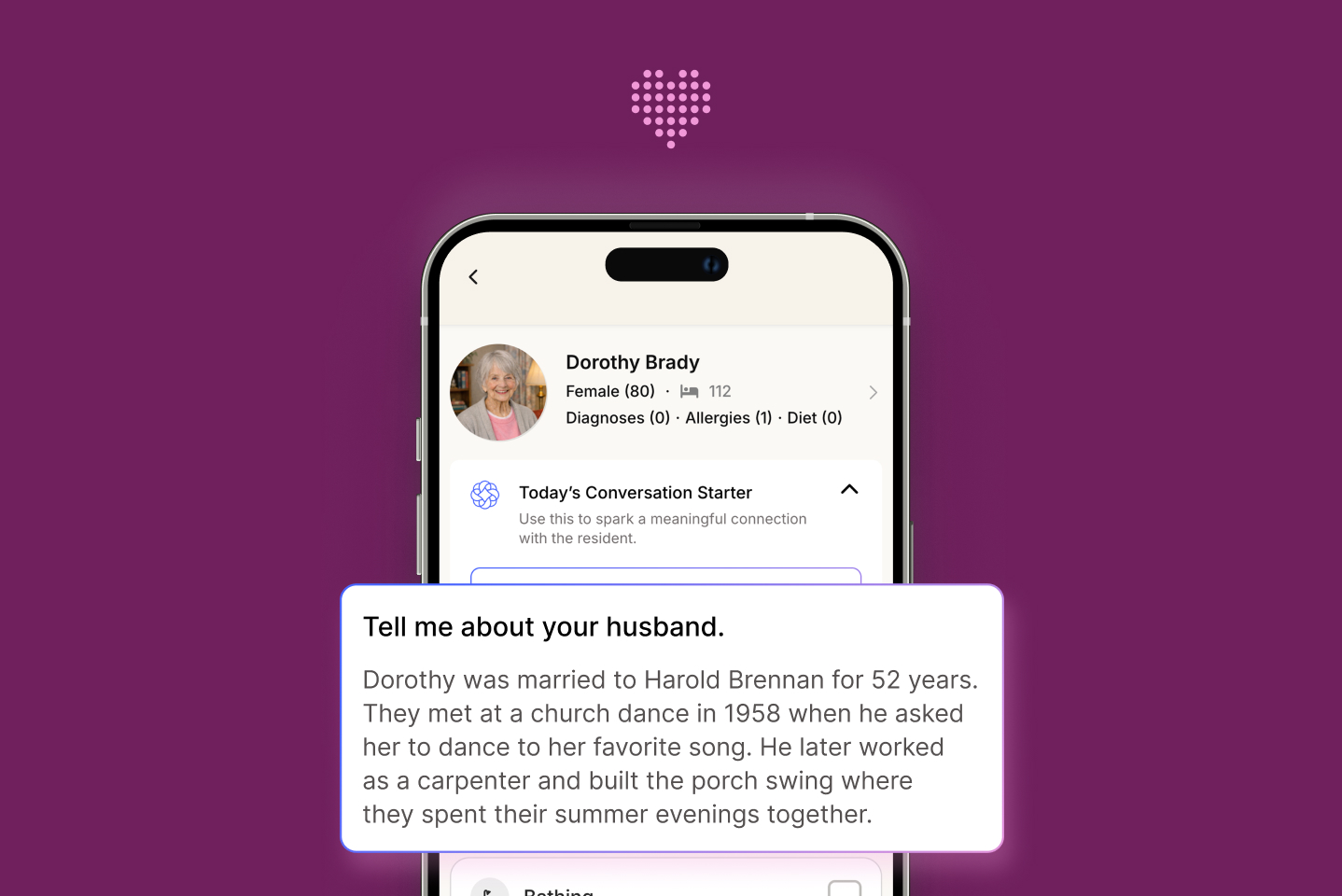
At August Health, we're taking a fundamentally different approach. We believe AI should meet teams exactly where they are. So instead of just creating another chatbot, we built August Intelligence directly into the back end. It embeds critical, proactive context right where staff work, surfacing information naturally throughout their shift.
Here's what this invisible, workflow-integrated AI looks like in action, and how it's helping to reduce cognitive load for staff while elevating resident care.
1. Translating Conversational Speech into Clear Documentation
How care gets documented is constantly evolving, but it can still look very different from community to community. While some are still carrying a notepad and spending the final moments of a tiring shift typing up notes from memory, others have turned to hardware-heavy solutions that try to automate it with wearable beacons, only to be undone by battery failures, compliance concerns, or caregivers who simply won't wear them. August Health Care Track introduced a way to chart at the point of care: checking off routines and noting observations from any mobile device. But tapping and typing still pulls a caregiver's hands and eyes to a screen, in a setting where every minute with a resident counts.
Voice-to-Chart, now available in Care Track, offers another option. Powered by August Intelligence, the system doesn't just perform basic voice-to-text transcription. It interprets conversational speech, in any language, and translates it directly into structured, charted actions. For instance, if a caregiver says, "I helped Mary brush her teeth", August Intelligence interprets the words, maps them to the "Oral Care ADL" data field, and automatically logs it as a completed task or as unscheduled care if this particular ADL isn't currently on Mary's service plan.
Task completions, exceptions, effort levels, observations, and notes are all captured without pulling the caregiver's attention away from the resident. And nothing goes on the resident’s chart until the caregiver confirms it. August Intelligence shows them what was captured and allows them to correct anything that feels inaccurate before submitting. Voice charting speeds up documentation, as opposed to blindly completing it for them.
2. Aligning Every Intervention with Your Clinical Standards
Service plans are the backbone of care delivery, but the way they are built in most systems is broken. Providers are forced into one of two journeys: manually typing interventions from scratch, which leads to inconsistency across plans, or relying on rigid, generic templates that dilute community care standards. Either way, nurses get buried in repetitive data entry, leaving little time for the person-centered care details that elevate the resident experience.
August Health's Intelligent Service Plans offer a new path, one that puts your community's unique care philosophy at the center of the technology. Powered by August Intelligence, the system looks at how your community delivers care and automatically matches resident needs to your preferred interventions, frequencies, and responsible parties.
Whether a plan is being generated by a brand-new nurse on day one or a veteran Wellness Director, Intelligent Service Plans ensure your community's unique protocols and clinical standards are reflected for every ADL, as well as high-risk protocols for conditions like falls, elopement, and wound care.
By automating this clinical baseline to your community's standards, the system saves nurses hours on paperwork. Nurses simply review the interventions that were added and can remove or add anything additional as they deem appropriate. They can then redirect their attention on refining the deep, relational details that help residents feel truly at home: Mrs. Johnson's preference for lavender soap, Mr. Chen's need for extra time dressing, and the redirection strategies that work best for Ms. Anderson.
Nurses are always in control of the service plan, just supported along the way.
3. Replacing Paper and Memory with Automated Summaries
Shift changeovers represent one of the most vulnerable operational moments for continuity of care. Historically, these conversations rely on caregiver memory and informal paper notes, which, when you're working with dozens of residents a day, increase the likelihood of critical updates being overlooked, putting continuity at risk.
Caregivers already document a huge number of important care details during their shift. They shouldn't have to spend their final minutes on the clock trying to manually recall those events or scribble them onto a paper cheat sheet. The system should work for them.
That is exactly how Shift Handoff supports your team. Without requiring a single ounce of extra documentation or double-entry, it automatically extracts the care details already captured throughout the day and organizes them into a concise digital summary.
Shift Handoff doesn't author new observations or interpret events. It surfaces what your team already charted during the shift and arranges it so the incoming team can see it at a glance. The judgment stays with the people who were there.
Grouped into a single view, the events let incoming teams instantly see which residents are on alert, who had a notable occurrence, and which routines were missed. By removing the cognitive burden of remembering every single detail, Shift Handoff ensures that changeover conversations are complete, documented, and focused entirely on what residents need next.
From Time-Saver to True Clinical Partner
When AI is built directly into your software rather than tacked on as an extra step, it moves from a well-intentioned feature to an integrated step in your day. Advanced AI solutions like August Intelligence can look across the entire community to surface macro-patterns that would take a clinical leader hours to spot manually: early signals of resident decline, documentation gaps. This lets clinical teams intervene earlier, before a decline becomes a hospitalization.
Integrating an AI co-pilot into your workflow does not automate away the heart of senior living. By absorbing the administrative and cognitive weight on the back end, it frees your caregivers and nurses to do exactly what they joined the profession to do: provide deeply human, relational care to the residents who depend on them.
Click here to see how August Intelligence works quietly across the August Health platform, surfacing the right context right where your teams already are.